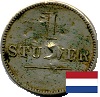
obverse lettering: 900 Jaar - 1 Mijdje
reverse lettering: Mijdrecht - 1085-1985
It is a commemorative token celebrating 900 years after first mentioning of the town of Mijdrecht. The denomination "1 Mijdje" is obviously a modern fantasy - the town has never had its own currency. Probably it's a wink to the word 'meisje'
girl, to make it sound as 'a girlie' or something like that.
Mijdrecht is a small village (pop. 16500) south of Amsterdam. In fact so small that it is no longer a municipality of its own (it's now part of the municipality of Ronde Venen).
Around 1000 AD, the area consisted of uninhabited marshes. In 1085, the bishop of Utrecht granted the rights to exploit the area, called 'Midreth' on the charter, to some religious organization. Exploitation started with cutting down forests and starting agriculture. Due to bad water management, agriculture became soon impossible, and the inhabitants started to dig up the marshy soil to sell it as fuel (peut, turf). From the 14th century, peutery turned large stretches of land into open waters. The Vinkeveense Plassen, a popular water recreation area south of Amsterdam, are remnant of this. In the 17th-18th century, many of the open waters were enclosed by dikes, the water pumped out and turned into farmland again (polders). In 2003, after a very dry summer, one of these old circular dikes broke,
flooding part of the neighbouring town of Wilnis (no casualties, just damage).
Taking into account the low number of inhabitants of Mijdrecht, your token will not have been produced in high volumes. I found only one for sale on
Marktplaats, for €3.50.
A
Dutch site dedicated to tokens lists dozens of city tokens, but not your one. Remarkably, it does have a
city token of Wilnis, commemorating the very same event (Wilnis is mentioned on the same charter as 'Midreth'), with a mintage of 1000 pieces.
This makes it the more interesting how this token ended up on Cyprus?